

UX design / Research reporting
Sleep Diaries
Turning a research survey into a clear daily interaction.
The 2025 Sleep Diaries prototype translates a paper sleep-research survey into guided morning and evening entries for older adults.
01 / Research context
The survey stays precise. The interaction becomes clearer.
Our team worked with sleep researchers during an academic study-abroad project in Newcastle. The brief was to redesign a survey for older adults, preserving subjective reporting after waking and before bed while reconsidering how each question is presented on a phone.
Academic readings, older-adult interface guidance and comparison with Consensus Sleep Diary informed the work. Paper forms place questions beside repeated date columns. We explored a guided sequence with clearer controls and fewer competing decisions on each screen. Accessibility was a design objective, not a measured outcome.
Reference artifact / Presentation p. 6
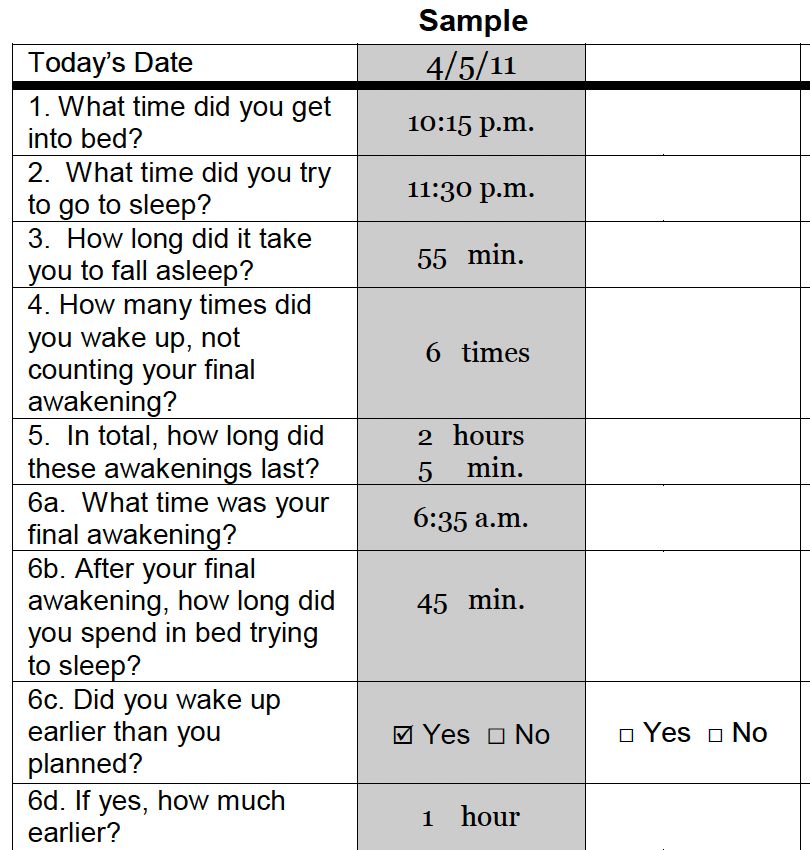
A survey, not an open-ended journal.
The paper diary records sleep timing and subjective experience. This extract includes the source form’s sample column, not data collected by our team.
Ideation evidence / Presentation p. 10
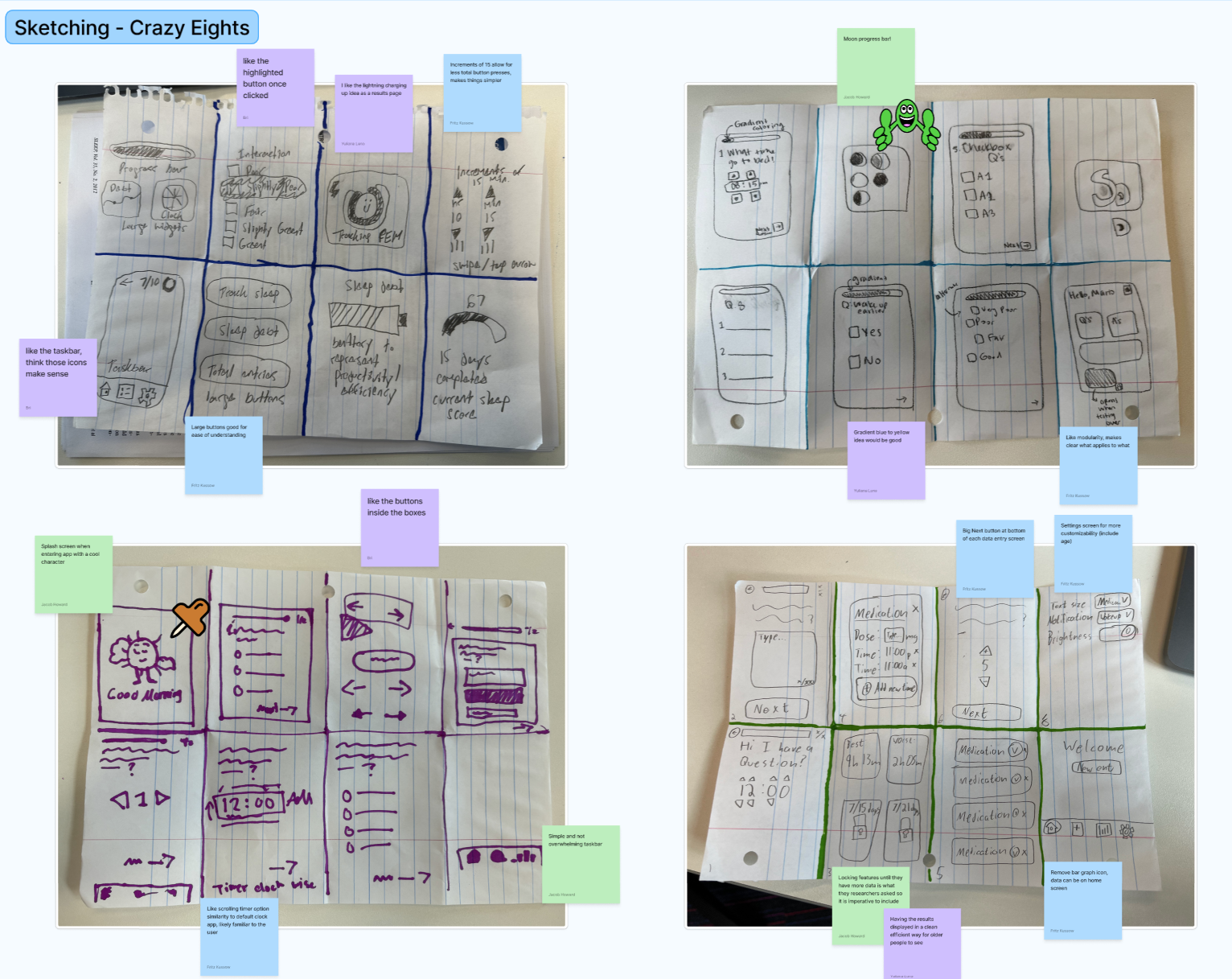
Exploring how an answer is entered.
Sketches and peer comments explore larger controls, visible selection and a consistent place for the next action. They document interface ideas, not a participant affinity study.
02 / From paper to mobile
Two moments organize the day.
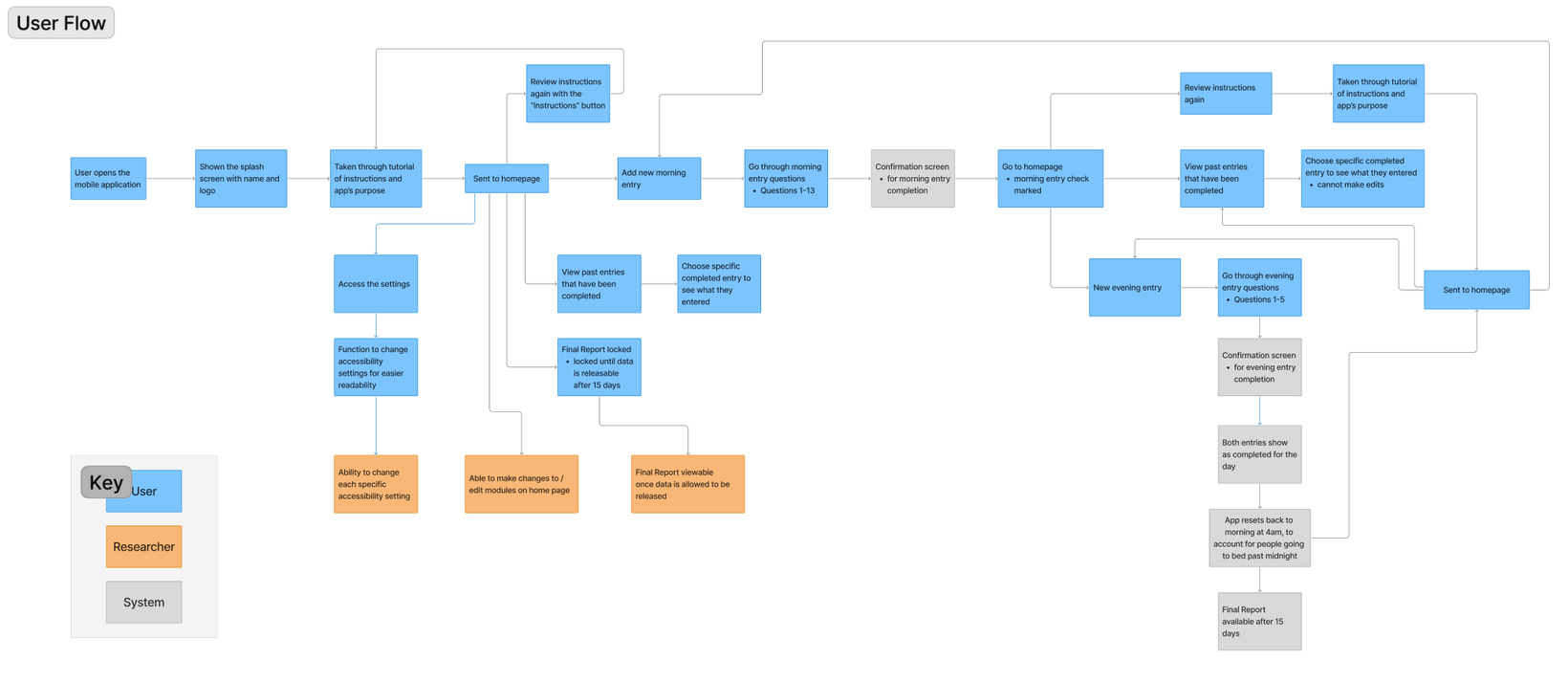
Morning Diary asks about the previous night. Evening Diary asks about the day before going to bed. The flow map connects these sequences to a shared home, instructions, past entries and settings, while distinguishing participant actions from researcher-controlled study rules.
The structure includes 13 morning question groups and five evening question groups, with conditional follow-ups. These are interface counts, not research-participant metrics. The proposed report-release cycle belongs to the product model, not a longitudinal study completed by our team.
03 / Design changes
Make the action explicit.
The team evaluated the prototype through peer interviews, usability sessions and feedback from the sleep-research collaborators. The authored account describes participants simulating older-adult needs. Participant composition and counts are incompletely documented, so this is not presented as testing with verified older adults.
Feedback informed time input, text and icon clarity, navigation and entry locking. We explored explicit increment controls in place of the reference clock picker, making hours, minutes and AM/PM visible together. The comparison shows a design decision, not a measured improvement in task performance.
The authored account also records removing the day/night toggle. Morning and evening instead appear as distinct entry actions. No recovered image establishes the earlier toggle state, so that change is described rather than reconstructed.
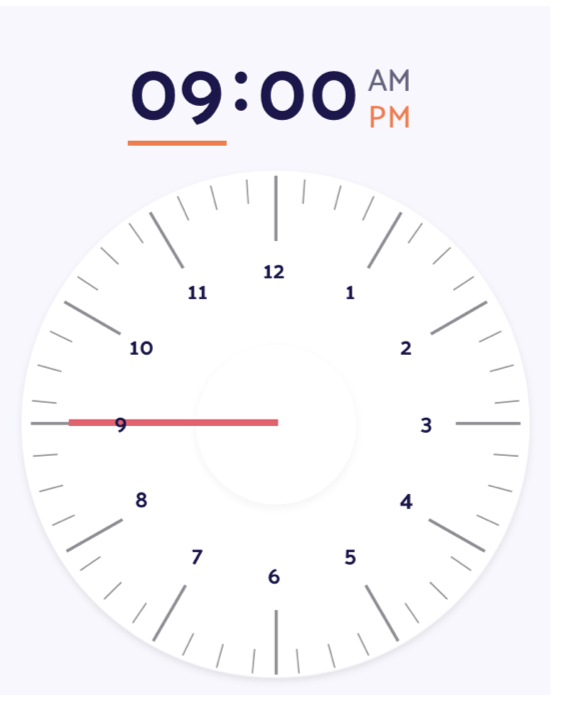
Reference / Previous approach
Clock-style picker
Time selection through a clock face in the reference interface.
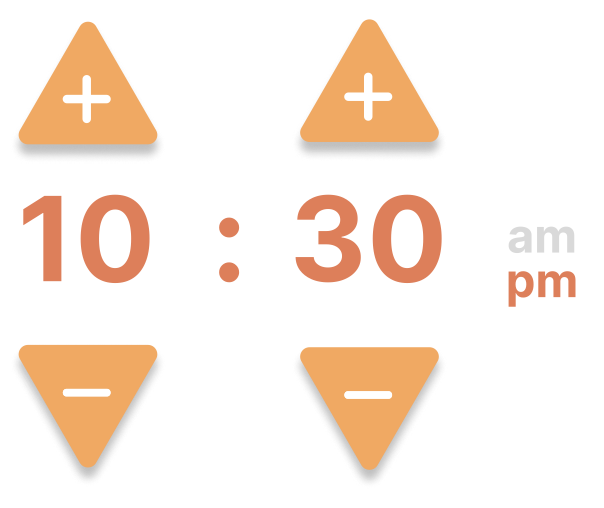
Sleep Diaries prototype
Explicit increments
Separate hour and minute controls with the current time and AM/PM state in view.
Both details come directly from the original presentation’s interface comparison (p. 16). They are not labeled as before and after usability testing.
04 / Morning + evening
A repeated pattern, with room for different answers.
Time, duration, selected answers and conditional details share a consistent question structure. The progress indicator keeps the current group visible, while Back and Next remain in predictable positions. Explore selected recorded states from each journey below; these are evidence views, not a functioning sleep diary.
Step 01 / 05
Enter bedtime
The first question asks when the participant got into bed. Explicit increments expose hours, minutes and AM/PM together.
Selected states from the verified walkthrough. The full morning survey has 13 question groups; this study does not show every frame.
Morning Diary: step 1 of 5, Enter bedtime
05 / Availability + history
Show what is ready, and what is already done.
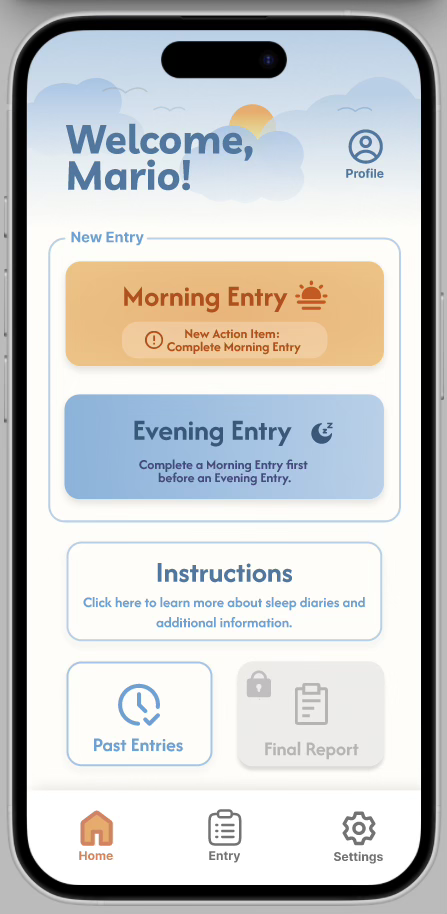
The home makes entry availability explicit: morning first, evening next, then both complete. These states express the intended reporting sequence. Labels and completion feedback accompany color, rather than leaving the distinction to orange and blue alone.
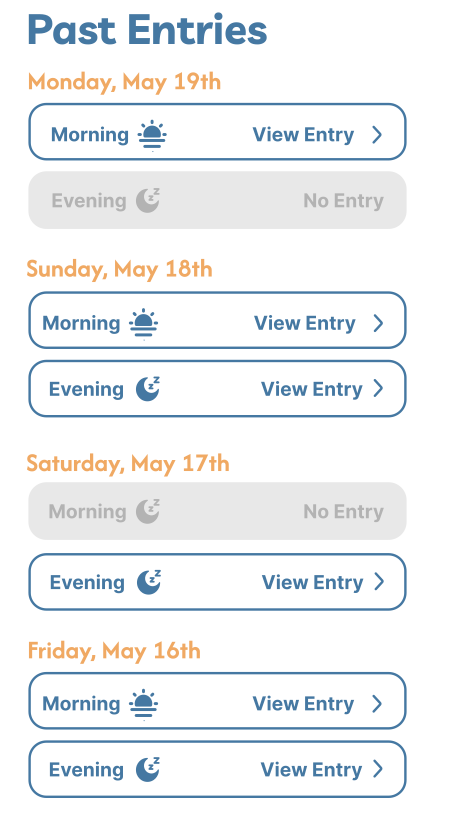
Past Entries groups morning and evening records by date, including unavailable entries. The intended review is read-only. The prototype communicates that structure, but does not establish saved records, functioning historical detail or improved reporting adherence.
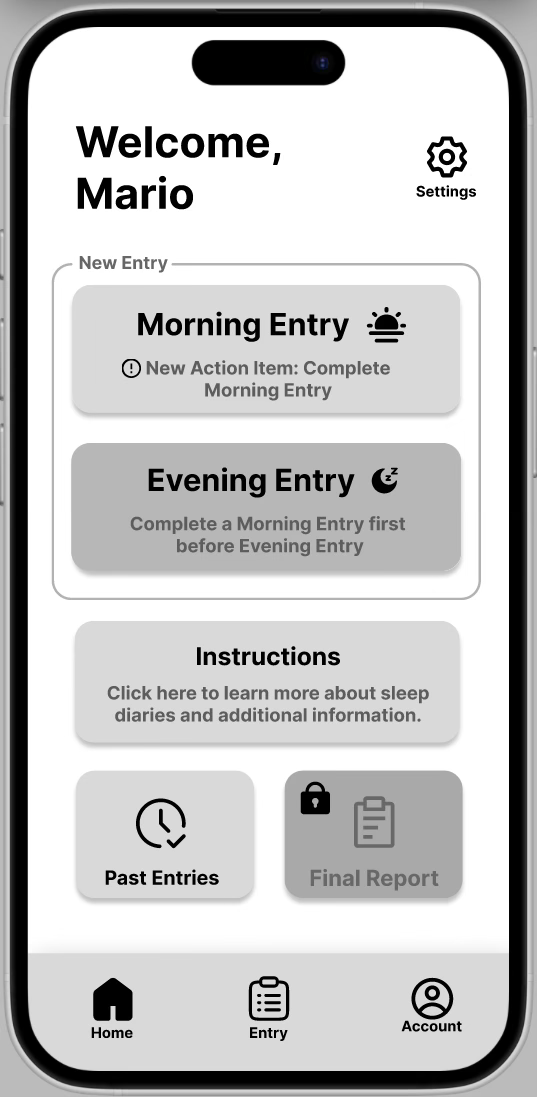
Development / Presentation p. 12
The state hierarchy in wireframe.
Morning and evening availability were already part of the low-fidelity home structure.
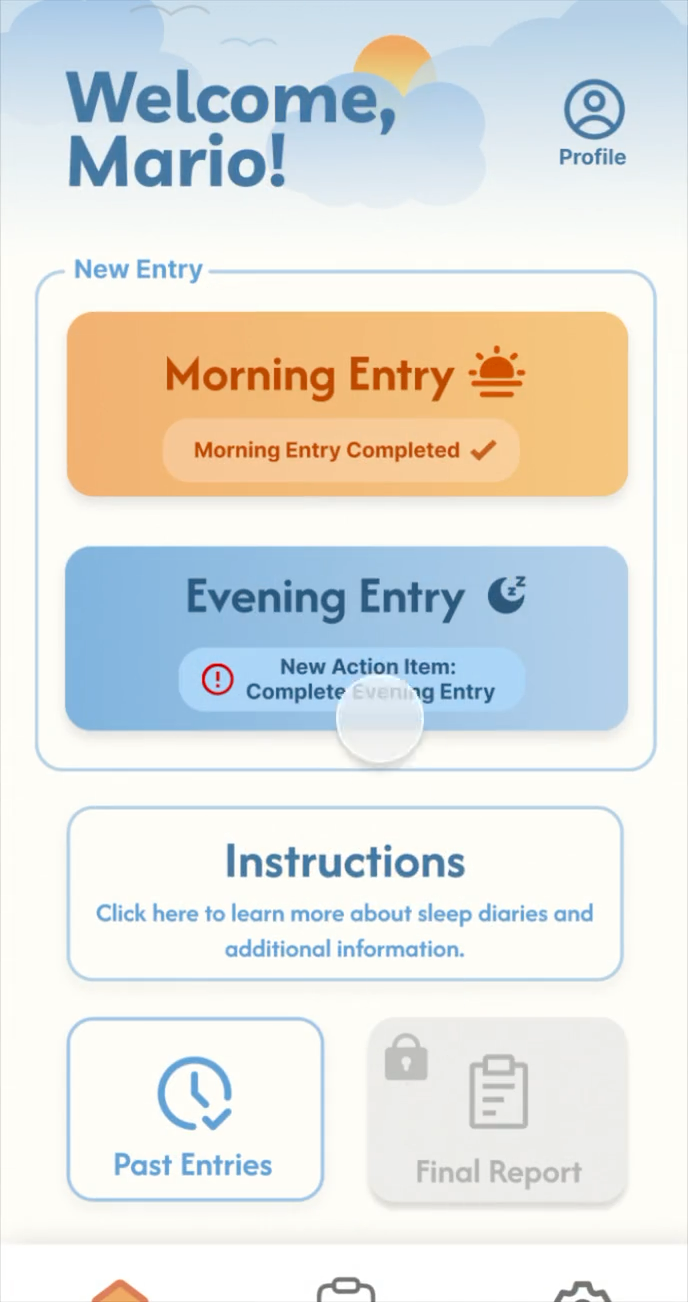
Prototype / Recorded state
The next daily action.
Morning completion changes the message on the home and makes evening reporting available.
Review detail / Presentation p. 16
A date-based record.
View Entry and No Entry labels distinguish available history from missing entries. This is a source-interface detail.
06 / Visual system
One interface language, two daily contexts.
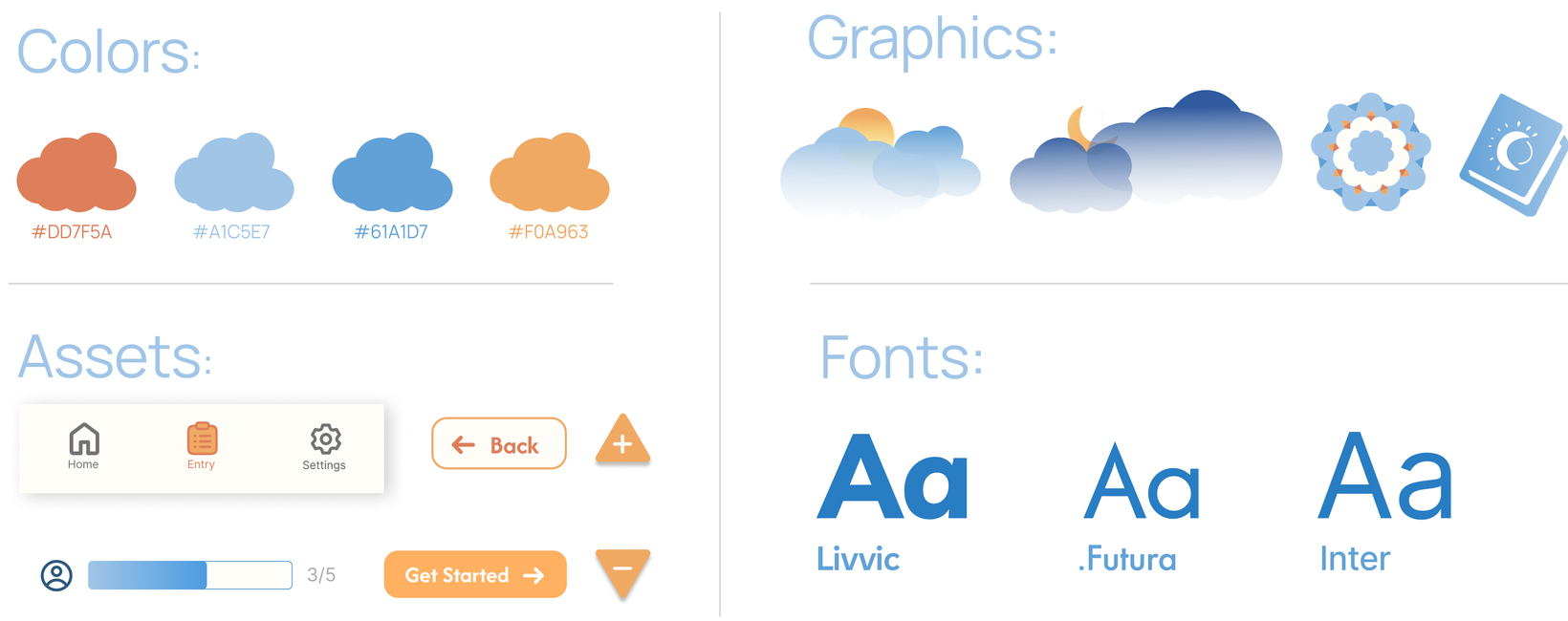
The documented palette pairs coral and amber with two blues. Cloud forms, moon imagery and the notebook mark connect the identity to the diary without changing the underlying question structure. Livvic, Futura and Inter appear in the product artwork; the portfolio keeps its own typography.
The presentation records the project colors as #DD7F5A, #A1C5E7, #61A1D7 and #F0A963. Repeated navigation, progress and increment controls connect the screens. The system expresses an accessibility intention, not formal compliance or validated assistive features.
07 / Prototype
Follow the interface in motion.
The silent walkthrough demonstrates selected screens and state changes. Playback is intentional here. The Figma prototype opens separately at its authored starting point; neither presentation implies a working clinical application, report engine or data service.
Explore the clickable prototype.
08 / 2025 design scope
The original design deliverable.
In 2025, our team produced a high-fidelity mobile prototype connecting daily survey questions, visible progress, entry availability and review. That academic deliverable demonstrated the reporting model; it did not implement data storage or clinical reporting.
At the final presentation, Night Mode, additional accessibility implementation, Final Report interactivity and post-study homepage changes were identified as future work. The proposed 15-day cycle was product intent, not a completed longitudinal study. Validation with the intended population and longitudinal evaluation were not established by our academic project; clinical deployment was outside its scope.
09 / Later outcome
From prototype to open source.
Our 2025 student prototype continued beyond the Digital Civics Exchange. Circadia Lab, Northumbria University, developed the design into a publicly available sleep-research application, with development led by Lucas França and Mario Leocadio-Miguel.
Circadia’s release and the live application credit Bri Baehl, Jacob Howard, Frederic Kussow and Yuliana Luna Colón for the design. Our contribution was the original UX, interface design and prototype, distinct from Circadia’s production implementation.
The current application supports morning and evening diaries, derived sleep metrics, local data storage and CSV/JSON export, with an open-source codebase. These are capabilities of the later Circadia application, not implemented features of the 2025 prototype. Its interface and feature set have continued to evolve.
Explore the Circadia application.
Reflection
Clarity without losing the question.
Translating a research survey is not just a visual simplification. Timing, sequence and the meaning of an answer must survive the move to a small screen. Our team’s work brought repeated morning and evening actions into one model, using consistent controls and visible state to reconcile research requirements with interaction clarity.
Project credits
A collaborative academic project.
Design team: Bri Baehl, Jacob Howard, Frederic Kussow and Yuliana Luna Colón.
Research collaborators: Lucas França and Mario Leocadio-Miguel. Academic guidance: Austin Toombs, Colin Gray and Paul Parsons.
Presented May 23, 2025, during the Newcastle study-abroad project. Team activities are credited collectively; individual responsibilities are not itemized in the source documentation.
